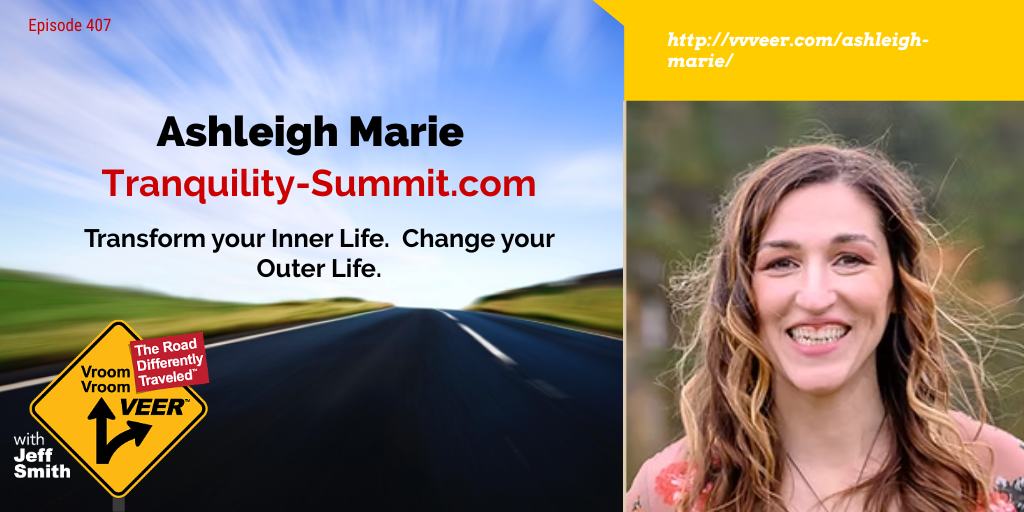
Ashleigh Marie – Leaving the Cult of Achievement, Reiki, and Rewriting Your Reality’s Prompts
Podcast: Play in new window | Download (Duration: 43:38 — 50.0MB)
Ashleigh Marie from her about page
“From a young age, I was deeply aware of the unseen—keenly intuitive and naturally attuned to energies around me. My fascination with the mind and higher consciousness led me to pursue a bachelors in neurobiology, with aspirations of becoming an academic researcher in the field of clinical neuropsychology. I worked for years building my research skills to help me understand the intricate connections between the brain, consciousness, and behavior. During this time, I published a handful of academic research papers (under the name Ashleigh Hover) pertaining to the neurobiological correlates of decision-making and behavior (see below).
After several years pursuing a career in academic research, I realized the types of research questions I was interested in – i.e., understanding the science consciousness – was not the type of questions that were easily funded; the primary types of research getting funded were those which supported pharmaceutical uses – something I did not care to support.
From there, my path took an unexpected turn into the business world, where I leveraged my analytical mind and gift for pattern recognition to build a successful career in data science and analytics. I specialized in creating predictive algorithms that mapped and forecasted human behavior, ultimately leading to a director-level role at a Fortune 500 company. Despite this professional success, a deeper calling persisted—the desire to help others awaken to their true potential, heal from within, and manifest a life aligned with their higher purpose.
This calling guided me back to my true passion: understanding the intersection of science and consciousness. My approach is a very grounded and scientific, integrating bioenergetic feedback, reiki energy healing, guided meditation, and hypnotherapy to unlock the mind’s power to support each person’s highest calling. I am honored to guide others on their journeys of self-discovery, healing, and personal mastery.”
Ashleigh Marie Vroom Vroom Veer Show Summary
This week on Vroom Vroom Veer, I sit down with Ashleigh Marie, a former neuroscientist and corporate machine learning leader who is now a transformational life coach. She blends hypnotherapy, energy healing, and somatic work to help people get unstuck. We start with burnout and end up in the default mode network, Terence McKenna’s time elves, and spontaneous stranger therapy. (Fair warning: the show is a little disjointed because I forgot to hit record. Consider it a feature.)
What Ashleigh does
- She’s a transformational life coach who combines hypnotherapy, energy healing, and somatic experiencing.
- She works with self-aware people who feel stuck, keep repeating patterns, or lack clarity.
- “Patterns” can be small (nail biting, quitting smoking or drinking) or huge (a lifetime of self-sabotage, or attracting assholes, as we put it).
- One-on-one coaching is available anytime, and a group cohort kicks off in January 2027.
The cult of achievement
- Where does the “get the shiny job, get the 1.2 kids, climb the next ladder” message come from? Corporate America, schools, media, and the culture in general.
- I call it “institutionalized productivity.” Once the bases are covered, more money doesn’t make you happier.
- At the peak of her corporate career, Ashleigh was earning well but outsourcing her life: kids in daycare nearly 12 hours a day, a housekeeper, constant takeout, and missed school events and bake sales.
- Engaging with your family is an actual life, and a great way to be busy.
- I talk about how I retired and stopped keeping busy on purpose.
The default mode network (and the ego)
- Ashleigh explains it as a pattern of neural activity generated by recurring decisions and actions, essentially your brain’s “default safety mode.”
- We compare it to the ego, whose main job is keeping you inside the bounds of what feels safe.
- Psychedelics turn the volume down on it, and so can meditation. She describes it as a hypnagogic, between-awake-and-asleep state where the brain floods with serotonin. Some deep shamanic or meditative states may also release DMT naturally.
- We take a detour into Terence McKenna and the “time elves.” If you haven’t done a McKenna deep dive, it’s scary, fun, and hilarious.
Ashleigh’s story
- She went from academia to corporate for about 10 years, and the core identity stayed the same: I’m so smart, and I need titles and things to prove it.
- Having kids wasn’t compatible with academia, and corporate hours turned out to be worse, with always-on phones, email, and Slack/Teams.
- Around 2020, a spiritual awakening showed her that her “intelligence” was really intuition and emotional receptiveness that had been mislabeled.
- She left the big suburban house for a tiny town in western North Carolina and slowly dialed down her job: remote work, then part-time, then handing off responsibilities. At one point she had 15 teams under her.
- The hardest parts were letting go of the paycheck and the fancy title, and not leaving close colleagues in the lurch.
- Her scientific grounding is what makes her approach different. She can talk about intuitive work in a very grounded way, and science is catching up.
Building the practice
- She launched her coaching practice on the side while working part-time, testing out her offers.
- She’d trained in Reiki, shamanic practice, hypnotherapy, and coaching, but marketing each separately didn’t work. Most people don’t search for “Reiki,” they search for help.
- Now she markets what she can help with and combines whatever modalities fit.
- Clients were arriving with heavy things, so she’s currently working on a master’s in counseling to be better prepared.
Reiki, hypnotherapy, and “weird thoughts”
- She learned Reiki after a persistent, odd thought: a friend’s daughter had recurring seizures, and she wanted to help. At no point would her corporate brain have said “learn Reiki.”
- Her advice is that when you’re trying to get back on your path, follow the super weird thoughts.
- Hypnotherapy is guided meditation that lets you talk with your subconscious about the beliefs driving your experience.
- I share my own first Reiki experience from massage school, which felt like what a trip might feel like. The big lesson was that you do very little, and that’s the point.
Your beliefs as the “prompt” for your reality
- Ashleigh’s theory is that reality works like an AI visualization, with your beliefs and emotions as the prompts.
- Client examples:
- A client who kept attracting liars and cheaters was running a core belief that she didn’t value herself. Once that shifted, better partners showed up.
- Clients who feel like a burden find those “burdens” resolve once the belief clears.
- A belief that you have to work hard to earn love is common, especially among men, and often comes back to not loving yourself enough.
- She points to the reticular activating system (focus on a Tesla and you’ll see Teslas everywhere), the double-slit experiment, and the Penrose–Hameroff theory of quantum processes in neurons. These are her interpretations and speculations, so treat them as food for thought.
Spontaneous stranger therapy
- Ashleigh gets strangers pouring out their hearts in grocery lines, coffee shops, and playgrounds. She thinks it’s an open-energy thing.
- I share my bar-at-the-airport story, a delayed flight, and a near-miss with a left-behind bag.
- We talk about how people are starving for real connection, and how the “third place” (somewhere that isn’t home or work) has disappeared for a lot of us since lockdown.
Quit-the-job lessons
- I share how I left my “chill” job and why it was hard. It was a third place full of great people, and leaving felt like hurting their feelings.
- Both of us knew we were ready before it happened. It was still scary.
Connect with Ashleigh
- Website: tranquility-summit.com
- One-on-one coaching is available anytime.
- Group cohort starts January 2027.
- She’s drafting a book and hopefully will be back to talk about it in six months to a year.