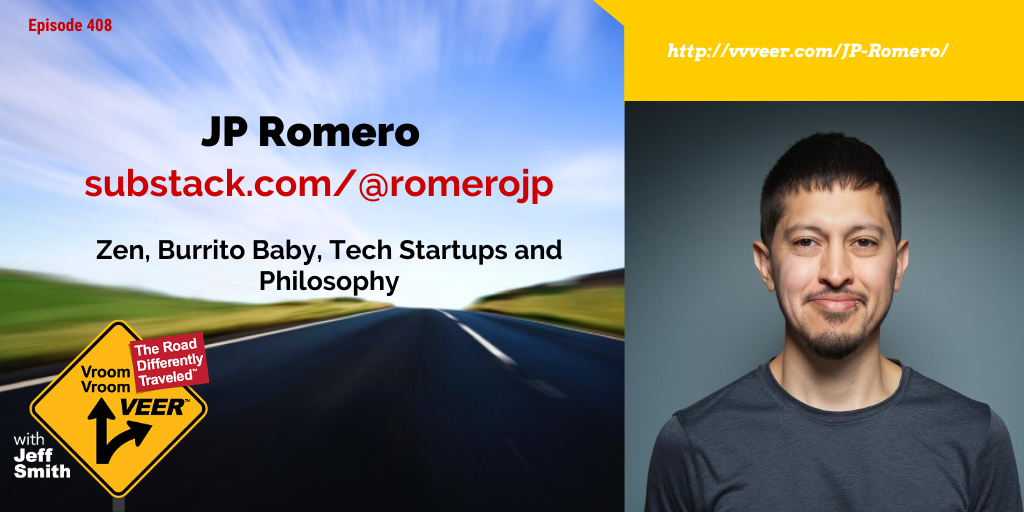
JP Romero – Zen, Burrito Baby, Tech Startups and Philosophy
Podcast: Play in new window | Download (Duration: 57:25 — 43.7MB)
JP Romero is an agnostic Mexican who is neither a monk, priest, nor any other kind of authority on Zen.
He was directly asked about his Zen practice and found he had to give the same Zen-based advice to people who suffered the same kind of problems, so he decided to write a book.
He studied Secular Zen Buddhism by cherry-picking from lectures, books, and internet musings by Alan Watts, Bret W. Davis, Charlotte Joko Beck, Kōshō Uchiyama, Muhō Noelke, Robert M. Pirsig, Steve Hagen, Shunmyō Masuno, Shunryū Suzuki, Taisen Deshimaru, and Takafumi Zenryū Kawakami.
In addition to Zen, his personal eclectic philosophy stack includes Stoicism (for the virtue ethics framework) and Existentialism (replacing Stoic metaphysics).
He lives in Mexico with his wife, kid, and dogs.
JP Romero Vroom Vroom Veer Stories
Vroom Vroom Veer: JP Romero
Guest: JP Romero, writer, Zen practitioner, and former solution architect
Find JP: Substack at romerojp.substack.com, and on Instagram at There Is No Zen Mode
Episode Summary
JP was born in the UK, raised in Mexico by Mexican parents, and has a Japanese great-grandfather. He’s a computer scientist turned consultant turned startup survivor. In this one, we trace his veer from “Catholic on autopilot” through agnosticism, existentialism, stoicism, and finally Zen. Along the way we talk about identity, the cult of achievement, why meditation is “good for nothing,” and why the best way to fall asleep (or let go of anything) is to stop trying so hard. It was JP’s first podcast, and I got to enjoy a little beginner’s mind myself.
What We Talk About
- Two places to find JP’s thinking. His Substack is his eclectic rant space, pulling from existentialism, stoicism, and Zen. His new Instagram account, There Is No Zen Mode, is strictly Zen: everyday and grounded, with the mysticism stripped out.
- Growing up Catholic by default. In Mexico, faith is baked into the culture and even the language. JP was Catholic because everyone was, and he even considered becoming a priest.
- The questioning begins. Noticing that two Catholics could disagree and both be “right” sent him digging. We trade stories about the high school teachers who planted the first seeds of thinking for ourselves.
- The reluctant agnostic. Why “I don’t know” might be the most honest (and most courageous) answer, and why standing in the middle is like trying to be purple when everyone’s red or blue.
- Existentialism vs. nihilism. Nihilism looks at the void and says “why bother?” Existentialism says the void is good news: you’re free. Zen adds that the void is neither good nor bad. It just is.
- Jiko and Engi. The two Buddhist ideas at the heart of JP’s book. Jiko is how we build our identity. Engi is the web of interdependent processes we’re all part of. We dig into Zendiyo Kawakami’s river analogy: scoop a cup from a river and you have a cup of water, not a cup of river.
- Imposter syndrome, reframed. If our achievements (and mistakes) aren’t 100% our own, maybe imposter syndrome is onto something. You deserve a part of it, and that’s okay.
- Identity is always changing. Why pigeonholing yourself as “this kind of person” is a roadblock, especially when you remember the music and cartoons you loved ten years ago.
- Career veers. From computer science to developer to client-facing consultant to solution architect, then into the pressure cooker of a tech startup, with a new baby at home.
- Becoming a parent. The mindset shift is real. We swap stories about judging other people’s kids before having our own (and the Jerry Seinfeld fantasy of a mini-me who sits quietly next to you).
- When life piles on. How JP leaned on his philosophical backbone during a stressful stretch, and how trying to give friends advice made him sound like a self-help guru. That frustration is what led him to write his book.
- The cult of achievement. Who decided we must produce something? We talk Adam Sandler, Tim Ferriss, and the treadmill.
- Zazen is good for nothing. A favorite line from Muho of Antaiji. The moment meditation becomes a means to an end, you’ve missed it.
- Letting go is like falling asleep. You can set up good conditions, but you can’t force it. Plus my middle-of-the-night “I have to wake up before I go to sleep” trick.
- Noticing is the whole practice. The mind thinks; that’s what it does. If you caught yourself thinking and came back, you’re doing it right.
- Zen and religion. You can do Zen and be any religion, because it’s mostly about sitting. We also get into how Buddhism and Shinto blended in Japan (Ryobu Shinto) compared to how Catholicism arrived in Mexico, and a few observations from a Japanese funeral that felt a lot like a D&D cleric casting a ritual.
Quotes and Ideas Worth Stealing
- “Zazen is good for nothing.”
- You’re not a cup of river. You’re a cup of water, and the river is a process.
- Noticing that you’re thinking is the thing.
Resources Mentioned
- JP’s Substack: romerojp.substack.com
- Instagram: There Is No Zen Mode
- The Way app by Henry Shukman (Zen meditation)
- Zen Mind, Beginner’s Mind by Shunryu Suzuki
- The Myth of Sisyphus by Albert Camus
- Zendiyo Kawakami (Zen teacher JP follows)
- Muho of Antaiji (Soto Zen lineage)
Connect with JP Romero
You can find his philosophical rants at